Claire Obscur: Expedition 33

I should say up-front that I have terrible reflexes.
No, like, really awful. I’ve cunningly avoided games like Dark Souls in the past because I knew they would cause me pain and sadness. I didn’t realise going in that all Expedition 33’s combat would be what I think of as quick-time events, in the form of parrying (tricky) and dodging (slightly easier). Beautifully animated quicktime events! But ultimately, reflex-focussed combat.
So perhaps if I was good at it, my opinion would be more favourable. I can’t rule this out.
I’ve never played a JRPG before. I’m a big fan of Bioware and Projekt Red’s RPGs. “How much difference can a “J” make?”, I wondered. As far as I understand it, the J in JRPG, as well as meaning “Japanese”, also negates the “R”. In terms of role-playing, you get to make one choice in Expedition 33. That’s significantly below the going rate I’m used to, but I believe it’s normal in a JRPG. This made me grumpy, too.
Gosh, this is just going to be a list of reasons I was grumpy playing this game, isn’t it? I’m sorry.
I found it genuinely jarring when a character I thought was me started to do something quite extreme without... I don’t know... checking with me first. That’s when I realised that I wasn’t really role-playing as Gustav, and my only choices would be deciding in what order I should select the dialogue options. And, I suppose, choosing to have dialogue in the first place (I do wonder what kind of psychopath wouldn’t try to work through all the dialogue in a game). That the game then turns around and asks you to make a decision at the very end, I found somewhat galling. Oh, now you ask me, Expedition 33. It’s like I was working on a project with a complete control freak, and at the end they throw me a bone to make it feel like we both contributed.
The story and setting of this game is genuinely intriguing. For the first 20 hours of the game, I was playing for the story, in spite of everything else. I had all sorts of theories that did not turn out to be quite right. I felt like I was reading a fantastic novel where I kept having to pass a skill test to turn the page. This was vaguely annoying. It also made me sad when I realised that basically the only mechanic in the game was combat. Having a nice moment with a friend? Let’s have a fight. Meet a merchant and want to get them to show you their best items? Time for a fight. Wandering a village of friendly people? They want to fight you, anyway. Having a deep and touching moment with an alternative version of yourself at the top of a giant monument to your fundamental character failings? It’s clobbering time.
For pure variety, I was delighted to find a handful of fetch quests dotted around in the early game, which made for a nice change of pace.
I was relieved to find that it is possible to play this game while being shit at parrying and dodging... when deeper in the game, I found a few bonuses that allow you to benefit from taking damage, which was all I needed to get through most of the game. I refused to drop the difficulty down from standard, because I am a stubborn idiot. In Act 2, I was really having fun. There are beautiful settings and good dialogue in this bit. I cared about the characters. I was hankering for more plot development. I didn’t suck quite as much. I could explore the world, which made me feel like I had a bit more agency.
And then, came Act 3. I’m going to try to get as far as I can without spoilers, here, but at some point, you will need to look away if you’ve not played it (and care about being spoiled).
I was told by my friends that for balance reasons, I should pursue the main story first, rather than the standard role-playing game approach of finishing all side-quests first.[1] This felt weird, but I went with it because even the smallest wandering around elsewhere showed me I was not ready for anything else. I was disappointed to find, after the ending, that playing the rest of Act 3 happens BEFORE you complete the ending. So ultimately, if you follow everyone’s advice, you’ll:
- Finish the game,
- Load a save game from just before you finished the game,
- Wander around in a strange limbo before the end of the game happened, with your party all blissfully unaware of what’s about to happen.
More importantly, you may start acting all pre-cog, and find yourself despising members of your party for things they haven’t done yet. This is a weird feeling.
Crucially, this means that the story is, in a way, over before you play most of Act 3. I was nervous about this too, because often once I’ve finished a game's story, the addictive pull that tugs me through the game is snapped once the ending happens. I don’t know if I’ll ever play the rest of Act 3. Without that pull, and without the feeling that I’m actually progressing the story, it’s a lot harder to care. I would find the rest of the game a lot more compelling if I didn’t know what had already-going-to-have happened in my past/their future.
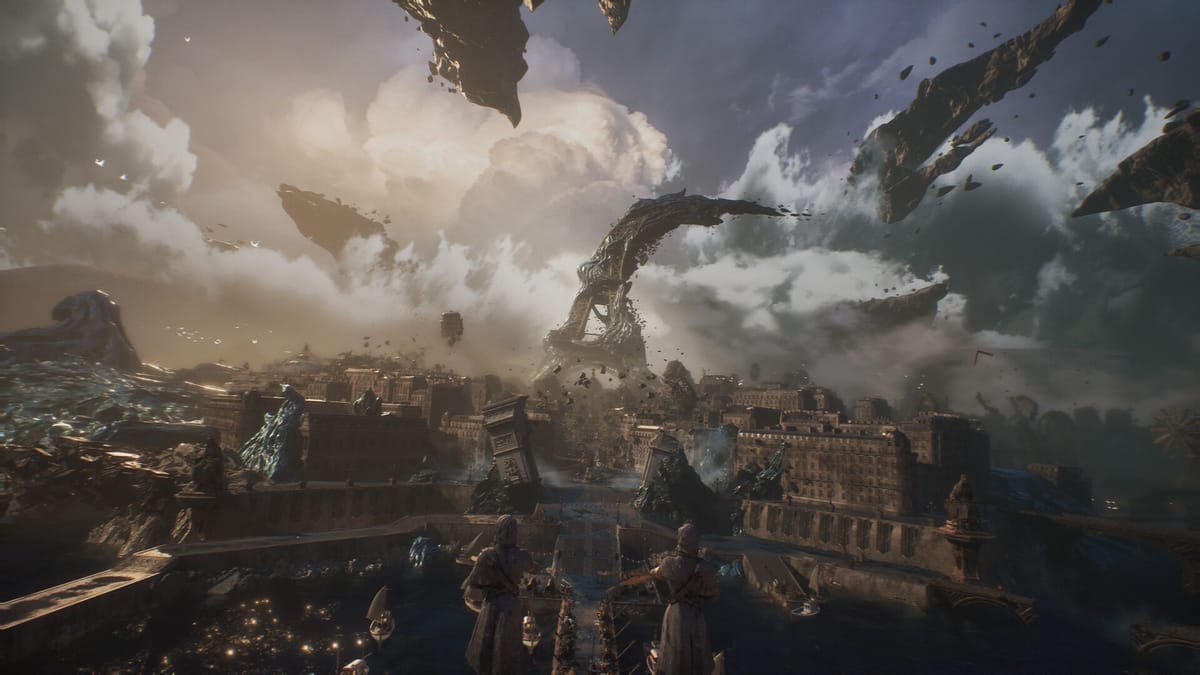
The game is beautiful, the voice acting is good, the music is amazing. A lot of the characters have their own musical theme, which is lovely, except that annoyingly, they often include the name of the character in the song, so it kind of feels like Jimmy walks into the scene and someone sings (in mesmerising French) “It’s Jimmy, it’s Jimmy, this is the bit with Jimmy in it”, which feels a little cheesy. I can’t speak French well enough to be sure that they are or aren’t actually saying this.
So... it’s a good, but frustrating game, with an unsatisfying ending on many levels. If you like JRPGs and dodging things, you will probably enjoy it a lot more than I did.
Spoilery discussion of the end
So. There are gods, and they’re an annoying family of fuck-ups in a world that looks more like ours, but not quite ours, because in their world, annoying fuck-ups have the power to create entire worlds full of living beings in the comfort of their own homes.
You discover that the character that you kind of suspected had a personal connection to the god-family... since she looked identical to one of them... is also suffering from an addiction to living in the world they created, just like you already knew her mum was. Two minutes later, you will need to choose to prioritise either:
- Her and her fake brother’s mental health, or,
- The fate of every living creature in the world you’ve just spent 100+ hours in, which includes the majority of your party
Annoyingly, Verso’s ending (aka number 1 above) is the most satisfying, because even though it hinges on Maelle’s newly-established addiction, at least his feelings towards reality and existence have been established well.
Maelle’s ending, also known as the one where you don’t commit a massive genocide, is less satisfying because she suddenly decides that not only is she an addict, she’s also a total arsehole. It’s like Game of Thrones all over again, except if Daenerys was accidentally wearing a beret and a baguette because you didn’t realise this bit was going to be quite serious.
- Unless you have reason to believe that your personal assistant is about to be blended in the universe’s most horrific nutri-bullet. I’m sorry, Kelly Chambers, I really am. ↩︎